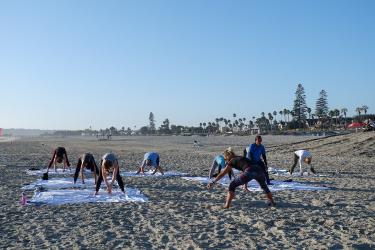
Isometric Exercises Build Muscle Without Moving a Single Joint
You’ve probably heard that building muscle requires heavy weights, explosive movements, and plenty of reps. But what if you could build serious strength without moving at all?
Isometric exercises challenge your muscles by holding a static position under tension. No gym membership required - no fancy equipment. Just you, gravity, and the willingness to hold still when your muscles start screaming.
What Makes Isometric Training Different
Most exercises involve two phases: the concentric (shortening) and eccentric (lengthening) portions of a movement. Think of a bicep curl-your muscle shortens as you lift the weight, then lengthens as you lower it.
Isometric training skips both - you hold one position. The muscle contracts but doesn’t change length.
This isn’t some new fitness fad. Physical therapists have used isometrics for decades to rehabilitate injuries. Martial artists use them to build crushing grip strength. And research published in the British Journal of Sports Medicine found that isometric exercises can reduce blood pressure more effectively than traditional aerobic exercise.
The science is straightforward: when you hold a position under tension, you recruit a high percentage of muscle fibers simultaneously. A 2019 study in the Journal of Strength and Conditioning Research showed that isometric holds at specific joint angles can produce strength gains comparable to traditional resistance training.
How to Structure Your Isometric Workout
Here’s a practical approach to incorporating static holds into your routine.
Step 1: Choose Your Hold Duration
Start with holds lasting 10-30 seconds. As you get stronger, work up to 45-60 seconds. Quality matters more than duration-a 20-second hold with maximum effort beats a sloppy 60-second hold every time.
Rest 30-60 seconds between sets - perform 3-5 sets per exercise.
Step 2: Pick the Right Exercises
Target major muscle groups with these foundational movements:
Wall Sit (quadriceps, glutes) Slide your back down a wall until your thighs are parallel to the floor. Keep your knees directly above your ankles. Your shins should be vertical - hold.
This burns - a lot. That’s the point.
Plank Hold (core, shoulders) Support yourself on your forearms and toes. Keep your body in a straight line from open heels. Don’t let your hips sag or pike upward. Squeeze your glutes and brace your abs as if someone’s about to punch you in the stomach.
Dead Hang (grip, lats, shoulders) Grab a pull-up bar with both hands and simply hang. Let your shoulders engage naturally. This builds grip strength while decompressing your spine.
Glute Bridge Hold (glutes, hamstrings) Lie on your back with knees bent and feet flat on the floor. Drive through your heels to lift your hips until your body forms a straight line from shoulders to knees. Squeeze your glutes hard - hold at the top.
Isometric Push-Up Hold (chest, triceps, shoulders) Lower yourself halfway down in a push-up position and freeze. Keep your elbows at 45 degrees from your body. Your chest should hover a few inches off the ground.
Step 3: Apply Progressive Overload
Progression with isometrics requires creativity since you can’t simply add weight. Try these methods:
- Increase hold duration by 5 seconds each week
- Add more sets
- Reduce rest periods
- Perform holds at different angles (a wall sit with thighs below parallel is harder than at parallel)
- Add instability (plank on a foam pad, single-leg variations)
- Use resistance bands or weighted vests once bodyweight becomes easy
Common Mistakes That Sabotage Results
**Holding your breath. ** This raises blood pressure dramatically. Breathe steadily throughout each hold. Inhale through your nose, exhale through your mouth. Shallow breaths are fine.
**Choosing positions that are too easy. ** If you can hold a position for two minutes without shaking, you need a harder variation. Challenge yourself.
**Ignoring joint angle specificity. ** Isometric strength gains are most pronounced at the specific angle you train. A wall sit builds strength primarily at that knee angle. Want more complete leg development? Train at multiple positions-deep squat holds, half squats, and quarter squats.
**Training only isometrically. ** Static holds work best as a supplement to dynamic training, not a replacement. Combine them with regular exercises for optimal results.
When Isometrics Make the Most Sense
Isometric training shines in specific situations:
**Injury recovery. ** When a joint can’t move through its full range safely, isometrics let you maintain and rebuild strength without aggravating the injury. Physical therapists often prescribe isometric quad sets after knee surgery for exactly this reason.
**Breaking through plateaus. ** Stuck at a certain weight on your bench press? Add isometric pause reps at your sticking point. Hold for 3-5 seconds at the hardest part of the lift. This builds strength precisely where you need it.
**Time constraints. ** A complete isometric workout takes 15-20 minutes. No travel to the gym - no equipment setup. You can knock out a wall sit and plank in your living room during commercial breaks.
**Travel or hotel workouts. ** When you’re on the road with no gym access, isometrics provide a legitimate training stimulus using nothing but floor space and maybe a wall.
A Sample 15-Minute Routine
Try this sequence three times per week:
- Wall Sit: 3 sets x 30 seconds (60 seconds rest)
- Plank Hold: 3 sets x 45 seconds (60 seconds rest)
- Glute Bridge Hold: 3 sets x 30 seconds (45 seconds rest)
- Isometric Push-Up Hold: 3 sets x 20 seconds (60 seconds rest)
Total time: approximately 15-18 minutes.
Track your hold times in a notebook or phone app. When you can complete all sets at the target duration, add 5-10 seconds to each hold the following week.
The Honest Limitations
Isometric training won’t replace a comprehensive strength program. The specificity issue is real-you’re building strength primarily at one joint angle. Athletes need strength throughout entire ranges of motion.
You also miss out on the eccentric portion of exercises, which plays a significant role in muscle hypertrophy. Research suggests that eccentric contractions cause more muscle damage (the productive kind that triggers growth) than isometric or concentric work.
And frankly, holding still for extended periods isn’t particularly exciting. The mental challenge of fighting the urge to quit can be as demanding as the physical effort.
But for what they are-accessible, equipment-free, joint-friendly strength builders-isometric exercises deserve a place in your training toolkit. They work - the research supports them. And sometimes the simplest methods prove most effective.
Start with the routine above - give it four weeks. Measure your progress. Then decide whether static holds earn a permanent spot in your program.