Longevity Fitness: Train for Healthspan Not Just Lifespan
Most fitness advice focuses on looking better or performing better right now. That’s fine if you’re 25. But what happens when you’re 65 and realize you can’t get up from the floor without grabbing a chair? Or 75 and afraid to walk on icy sidewalks because a fall could end your independence?
Healthspan-the years you spend in good health, able to do what you want-matters more than simply being alive. And the training that optimizes healthspan looks different from typical gym routines.
Why Traditional Fitness Misses the Mark
Conventional workout programs prioritize aesthetics or sport-specific performance. Bodybuilding splits - marathon training. CrossFit WODs - these aren’t bad. They’re just incomplete for longevity.
Here’s what actually predicts your quality of life after 60:
- Can you stand from a seated position without using your hands? - Can you carry two bags of groceries up a flight of stairs? - Can you catch yourself if you trip? - Can you reach overhead to change a lightbulb?
Researchers at the Clinimex Exercise Medicine Clinic in Brazil developed a simple sitting-rising test. People who scored poorly (needing hands, knees, or support to get up and down from the floor) had 5-6 times higher mortality rates over a 6-year follow-up. That’s not a typo. Your ability to sit and rise from the floor predicts death better than many medical tests.
The Four Pillars of Longevity Training
Peter Attia, a physician focused on longevity medicine, identifies four key physical capacities that determine your function in later decades: stability, strength, aerobic efficiency, and anaerobic peak output. Train all four.
Pillar 1: Stability and Balance
This comes first because it’s most often ignored-and most consequential when lost. Falls kill more than 36,000 Americans over 65 annually. Many more suffer hip fractures that permanently reduce independence.
Stability is more than standing on one foot. It’s your body’s ability to maintain safe positions under load and movement.
Practical steps:
1 - practice single-leg stance daily. Start with 30 seconds each leg. Progress to closing your eyes, then standing on an unstable surface.
- Include Turkish get-ups in your routine. This single exercise trains your ability to move between floor and standing while managing load. Start with no weight, learn the pattern, then add load gradually.
3 - walk on varied terrain. Sidewalks and treadmills don’t challenge your stabilizers. Hiking trails, beach sand, and uneven grass force your ankles, knees, and hips to adapt constantly.
4 - train rotation. Most falls happen during turning movements. Include cable chops, medicine ball throws, and rotational lunges.
Why this matters: Your proprioception (body position awareness) declines with age unless actively maintained. The neural pathways that keep you upright require regular practice.
Pillar 2: Functional Strength
Forget about bicep curls and leg extensions. Longevity strength means being able to control your body and move external loads through full ranges of motion.
The goal isn’t maximum muscle size. It’s maintaining the strength reserves to handle life’s physical demands with a comfortable margin.
Practical steps:
- Prioritize compound movements: squats, deadlifts, presses, rows, and carries. These train multiple joints and muscle groups together-exactly how your body works in real life.
2 - maintain full range of motion. A deep squat at 80 is possible if you practice it from 40 onward. Partial-range training creates partial-range capability.
3 - include grip work. Grip strength correlates strongly with all-cause mortality. Farmer carries, dead hangs, and thick-bar training preserve this key capacity.
4 - train the hip hinge pattern. Being able to pick something off the floor safely-whether it’s a grandchild or a dropped item-requires hip hinge competency. Deadlifts, Romanian deadlifts, and kettlebell swings build this pattern.
5 - don’t neglect pulling. Modern life creates hunched postures. Rows, pull-ups, and face pulls counteract this tendency and protect your shoulders.
Benchmark targets:
- Carry your bodyweight (split between two hands) for 1 minute
- Squat to a chair-height surface for 10 reps unassisted
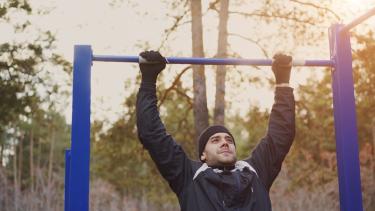
- Hang from a bar for 30+ seconds
Pillar 3: Aerobic Base (Zone 2 Training)
Zone 2 refers to an intensity where you can still hold a conversation, but it’s slightly uncomfortable. Your breathing is elevated. You could talk, but you’d rather not.
This intensity specifically trains mitochondrial function. Mitochondria are your cells’ energy producers, and their decline drives many aging-related problems.
Practical steps:
- Aim for 150-180 minutes weekly of Zone 2 work. This can be walking (uphill or brisk), cycling, swimming, rowing-anything that elevates your heart rate to roughly 60-70% of maximum.
2 - use the talk test. If you can speak in full sentences but don’t want to, you’re probably in the right zone. Gasping for air - too hard. Chatting easily - too easy.
3 - be patient. Zone 2 improvements take months, not weeks. The mitochondrial adaptations are slow but profound.
4 - consider morning fasted sessions. Some evidence suggests Zone 2 work before eating may enhance mitochondrial benefits, though this isn’t essential.
Why bother with this slow stuff? Because your VO2 max (maximum oxygen uptake) is one of the strongest predictors of longevity. Someone in the bottom 25% of VO2 max for their age has roughly 4x the mortality risk of someone in the top 25%. Zone 2 training efficiently builds this capacity without the injury risks of high-intensity work.
Pillar 4: Anaerobic Capacity (High-Intensity Work)
Pure endurance isn’t enough. You also need the ability to produce high power output briefly-sprinting to catch a bus, lifting a heavy object, responding to an emergency.
VO2 max peaks around age 30-35, then declines about 10% per decade if untrained. High-intensity training slows this decline significantly.
Practical steps:
- Include one to two high-intensity sessions weekly. This could be sprint intervals on a bike, rowing hard for 30-second bursts, or hill sprints.
2 - respect recovery. High-intensity work is a stress. More isn’t better, especially as you age. Quality over quantity.
Use a 1:3 or 1:4 work-to-rest ratio. Sprint for 30 seconds, recover for 90-120 seconds. Repeat 4-8 times.
Choose low-impact options if joints are compromised. Cycling and rowing deliver the cardiovascular stimulus without pounding your knees.
Troubleshooting tip: If high-intensity work leaves you wrecked for days, you’re either going too hard or not recovering enough between sessions. Scale back intensity or add another rest day.
Programming It All Together
A weekly template might look like this:
Monday: Strength training (lower body emphasis) + 10 minutes stability work
Tuesday: Zone 2 cardio (45-60 minutes)
Wednesday: Strength training (upper body emphasis) + mobility work
Thursday: Zone 2 cardio (45-60 minutes)
Friday: Strength training (full body) + stability challenges
Saturday: High-intensity interval session (20-25 minutes total)
Sunday: Active recovery-walk, light yoga, or just rest
Adjust based on your current fitness. If you’re starting from scratch, begin with two strength sessions and three Zone 2 walks weekly. Add complexity over months, not days.
The Mindset Shift
Stop training for how you want to look at 40. Start training for how you want to function at 80.
This means:
- Choosing exercises that build real-world capability over gym-specific performance
- Prioritizing consistency over intensity
- Protecting your joints rather than destroying them
- Measuring success by function, not aesthetics
The person who can hike with grandchildren, carry luggage through airports, and recover quickly from minor injuries is winning-regardless of their body fat percentage or bench press numbers.
Your future self is counting on decisions you make today. Train accordingly.